Investigative report
The DuPree Record
Promises, power and unanswered questions
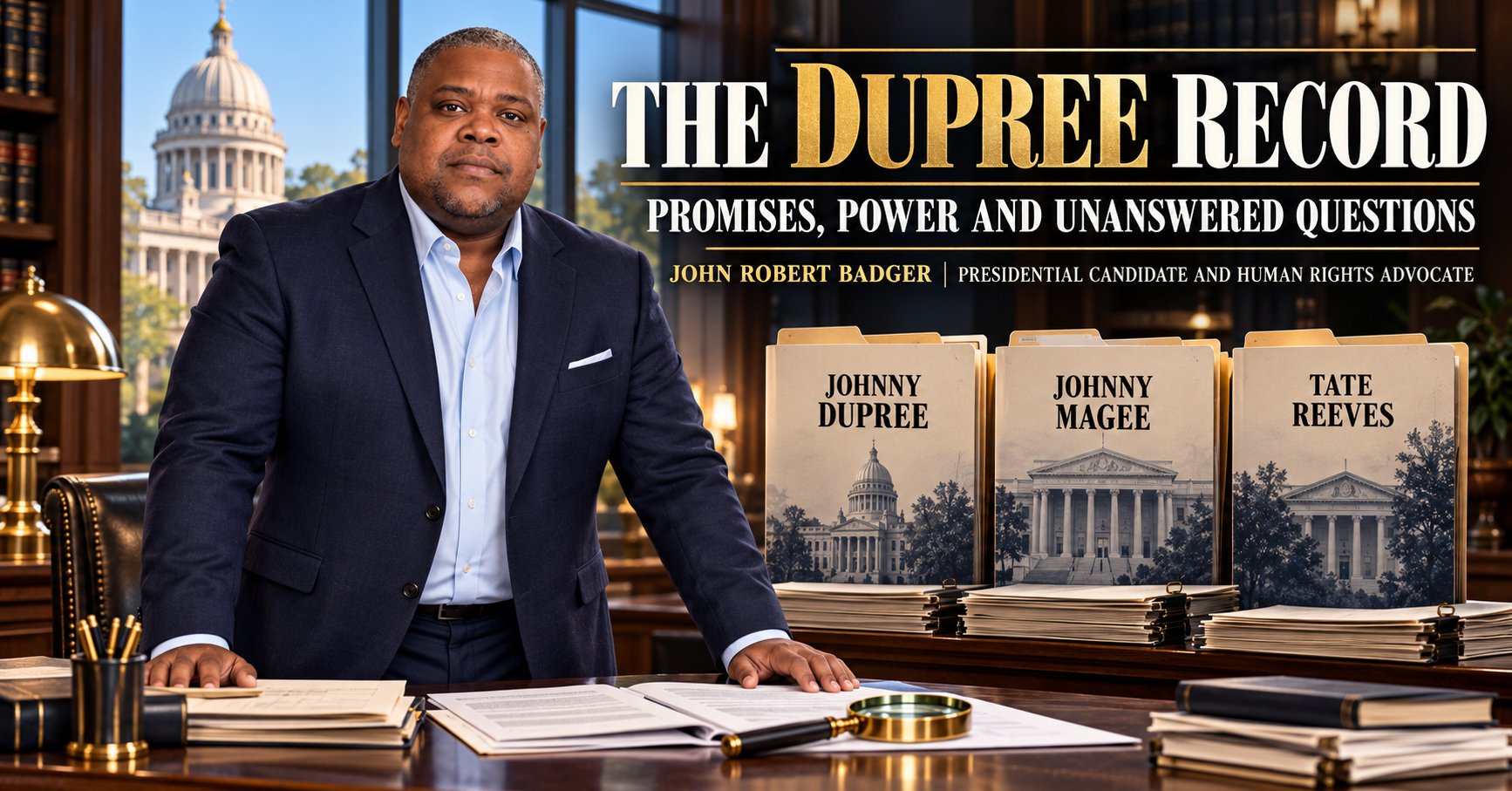
Johnny DuPree returned to elected office in January 2026 as the Mississippi state senator representing District 45. During his campaign, he told voters that Mississippi families deserved leadership that would fight for ordinary people rather than powerful interests. The public must now ask what he personally delivered.
Government officials regularly attend ceremonies, vote on legislation written by other people, appear at ribbon cuttings and issue supportive statements. That does not mean one official personally created, financed or completed the resulting program. Public service should be measured through records, legislation, appropriations, results and accountability.
A short Senate record
DuPree has not served in the Mississippi Senate for decades. He entered office on January 6, 2026. His lengthy political history comes principally from serving as Hattiesburg mayor from 2001 through 2017. He previously served on the Hattiesburg Public School Board and the Forrest County Board of Supervisors.
Because his Senate tenure is relatively new, it would be unfair to hold him responsible for every longstanding problem in Mississippi. It would be equally improper to allow campaign promises to disappear after an election.
The promises
DuPree campaigned on creating a Mississippi Earned Income Tax Credit, expanding Medicaid, protecting rural hospitals, increasing mental health resources, strengthening public education, protecting retirement benefits, promoting tax fairness, protecting voting rights and investing in neighborhoods.
Where are the measurable results?
I have not located evidence that a Mississippi Earned Income Tax Credit proposed by DuPree became law. I have not located evidence that Mississippi expanded Medicaid because of legislation authored and enacted by DuPree. I have not located a completed expansion of mental health services attributable to a DuPree proposal. I have not located comprehensive tax reform authored by DuPree that provided the promised relief to working families.
I have not located evidence that DuPree secured passage of a comprehensive statewide voting rights law, demonstrated a reduction in household expenses for District 45 families or published a complete accounting showing how much additional state funding he personally secured for the district.
If those records exist, the public should see them.
Voting is not the same as delivering alone
DuPree supported legislation that ultimately produced a $2,000 minimum salary increase for teachers and assistant teachers. That legislation may provide an important public benefit. However, DuPree did not personally finance the increase, and it would be inaccurate to describe a statewide legislative accomplishment as the work of one senator.
The measure required legislators, committees, appropriations, passage through both chambers and the governor's signature. DuPree deserves credit for his vote. He does not deserve exclusive credit for the result.
Attending a groundbreaking does not mean an official constructed the building. Standing at a ribbon cutting does not mean the official created the business. Supporting a resolution does not mean the official personally delivered the underlying benefit. Public officials should receive the credit established by the record, no more and no less.
Major promises remain unfinished
Where is the working family tax credit? Where is Medicaid expansion? Where are the expanded mental health resources? Where is comprehensive voting rights protection? Where is the documented reduction in household expenses? Where is the complete list of appropriations DuPree secured for District 45?
Which bills did he author? Which bills did he merely cosponsor? Which measures passed? Which measures died? Which promises were abandoned?
These are not personal attacks. They are questions every voter should ask before returning any politician to office.
The Hattiesburg wastewater record
During DuPree's mayoral administration, a September 2012 EPA inspection identified unreported sanitary sewer overflows. The matter eventually resulted in a federal consent decree and a corrective plan estimated to cost approximately $45 million.
The final settlement occurred after DuPree left office, and he did not create every problem associated with Hattiesburg's aging sewer infrastructure. Nevertheless, the underlying reporting failures were identified while he was mayor, and residents were left facing the financial consequences.
DuPree later vetoed a sewer rate increase because he argued that the cost would burden residents. If the rates were not increased, what was his complete and financially sustainable plan to repair the system, satisfy environmental obligations and prevent future costs? Did delaying the financial decision ultimately make the problem more expensive?
The court found him in civil contempt
A court found DuPree in civil contempt after he failed to submit qualified municipal department head nominees within the required period. Published reports indicated that completing all 17 appointments consumed nearly half the term. The contempt matter was later purged after the required action was completed.
Why did it take so long to appoint qualified leadership? Which departments operated without properly confirmed leadership? Did those delays affect public safety, financial supervision, code enforcement or municipal services? What costs resulted from the delay?
The federal construction compliance failure
Hattiesburg's fiscal year 2012 audit found that the city failed to comply with Davis Bacon Act requirements connected to federally funded construction. The finding does not establish that DuPree stole money. It establishes a federal compliance failure within the municipal administration he supervised.
Who reviewed the contracts? Who was responsible for collecting certified payroll documentation? Were workers paid every dollar required under federal prevailing wage rules? Did any contractor benefit from the city's failure? Was anyone disciplined?
Fraud inside a city administered housing program
A federal jury convicted Kenneth Fairley in connection with a scheme involving federally funded housing rehabilitation contracts issued through the City of Hattiesburg. Artie Fletcher also faced criminal responsibility. Federal authorities determined that work was performed for less than the amount represented under the government contract and that money was diverted for unauthorized purposes.
The Justice Department did not charge or convict DuPree. That distinction must be respected. The absence of a criminal charge does not eliminate legitimate questions about administrative supervision.
How did fraud operate through a city administered program? Who approved the participating organization? Who reviewed the proposed costs? Who inspected the work? Who authorized payment? What did DuPree know, when did he learn it and what corrective action did he order? Did the city recover every dollar?
The 2013 election controversy
DuPree's 2013 mayoral election was challenged after the initial count placed him ahead by only 37 votes. The dispute involved questions concerning voter eligibility, unsecured election materials and election administration. Litigation produced a mistrial, and another election was conducted. DuPree won the subsequent election by 217 votes.
The existing evidence does not establish that DuPree personally altered ballots or directed election misconduct. Nevertheless, the controversy damaged public confidence. What reforms did he demand? Did he support an independent review? Did he demand stronger ballot security? Were the officials responsible for the irregularities held accountable?
Johnny DuPree and Johnny Magee
The public record establishes interaction between DuPree and Laurel Mayor Johnny Magee. They participated in public civic competitions between Hattiesburg and Laurel, attended regional events and operated within overlapping Pine Belt political and municipal networks.
Those contacts do not establish a corrupt agreement. They establish familiarity and political proximity. How frequently did they communicate while serving as mayors? Did they discuss contracts, development projects, appointments, elections or candidates? Did either recommend appointees, contractors, consultants or candidates to the other? Were campaign contributors shared between their political organizations?
Johnny DuPree and Tate Reeves
DuPree also had official contact with Tate Reeves while Reeves served as lieutenant governor. In 2017, Reeves visited storm damaged areas alongside DuPree and other officials. That appearance concerned official disaster response.
A more consequential relationship concerns redistricting. DuPree won Senate District 45 after court ordered redistricting created new electoral opportunities. Reeves was part of the state election authority involved in the litigation and later supported legal action affecting the court ordered arrangement.
Have Reeves and DuPree communicated privately about District 45, legislative priorities, appointments, appropriations or future elections? Has DuPree supported measures important to the Reeves administration? Has the governor approved funding requested specifically by DuPree? Have intermediaries communicated between them?
Is DuPree part of a political protection plan?
The presently available records do not establish a political protection agreement among Johnny DuPree, Johnny Magee and Tate Reeves. The public record does justify examining the question.
Political protection can operate through appointments, selective endorsements, coordinated silence, favorable contracts, controlled access, shared consultants, campaign contributions, redistricting decisions or strategic candidacies.
Is that happening here? The honest answer is that the records reviewed so far do not establish it. That is why communications, calendars, campaign filings, contracts, financial disclosures, appropriations and appointment records matter.
Let the record answer
This investigation is not based on a predetermined conclusion that Johnny DuPree is a bad person. It is based on a fundamental principle. Political longevity is not proof of public accomplishment. Campaign promises are not completed policies. Attendance is not authorship. A vote is not personal financing. A photograph is not evidence of delivery.
The public deserves an accurate record showing what DuPree promised, what he personally did, what required the work of other officials, what failed, what remains unfinished and who benefited.
John Robert Badger
Presidential Candidate and Human Rights Advocate
October 4, 2026
Sources and public records
- Johnny DuPree: News From the Capitol
- Mississippi Today: 2025 Senate special election guide
- Mississippi Legislature: 2026 legislation summary
- City of Hattiesburg: fiscal year 2012 audited financial report
- United States Department of Justice: Hattiesburg housing fraud sentencing
- Hattiesburg wastewater consent decree background
- WAPT: civil contempt proceeding involving department head appointments
- WDAM: documented public interaction between DuPree and Magee
- WDAM: official storm visit involving Reeves and DuPree
Correction policy: Documented responses and factual corrections from any person named in this report may be submitted for review. Material verified corrections will be identified transparently.
Published comments
No comments have been published yet.
Public conversation
Share your thoughts
Comments are reviewed before publication. Please discuss the issue respectfully and do not post private information.