Investigative report
Follow the Dollar
Why I am investigating the financial operations of the Town of Rayville, Louisiana.
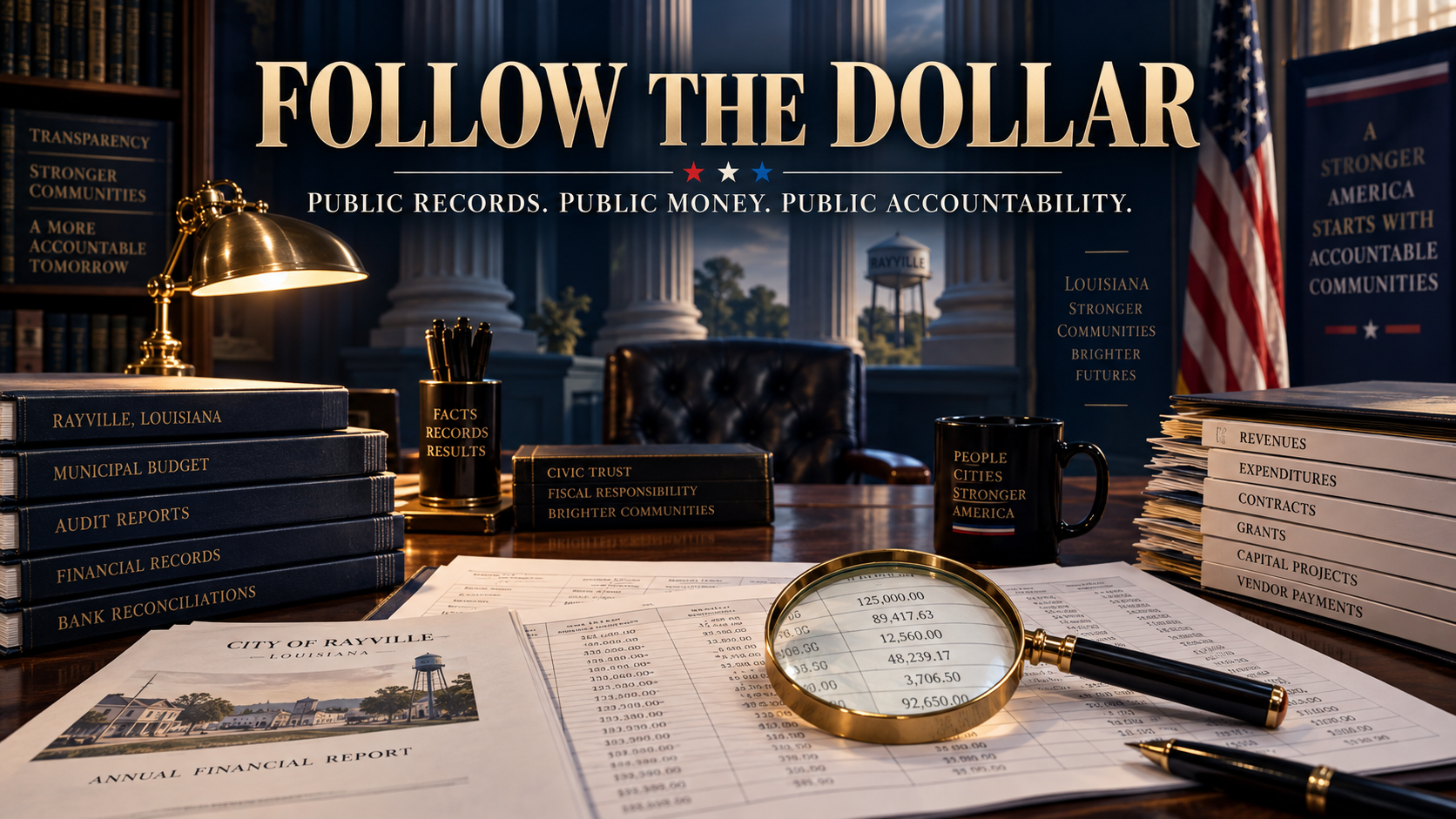
People keep asking me the same question: Why are you in Rayville? My answer is simple. I did my homework.
I did not wake up one morning and decide to target a mayor, an alderman, an alderwoman, a town clerk or anybody else. I started looking at documents. I reviewed the Town of Rayville’s financial audits, findings submitted to the Louisiana Legislative Auditor, corrective action plans, budgets, council records and the public responsibilities assigned to the governing body.
This report is not an accusation that any specific person stole money or committed a crime. It explains why I believe the Town’s financial operations deserve substantially greater scrutiny. My work is an independent public records review. It is not a governmental criminal investigation.
The paper trail did not start in 2026
The financial control issues described in the reports I reviewed predate the current administration. That matters. This is not simply about Mayor Consuela Hunter. Historical Town records identify former Mayor Harry Lewis and a governing body that included Jerry Gordon, Paula Cumpton, Joseph Fletcher, Consuela Hunter and Debra James. The Town’s own website describes the Town Council’s responsibilities as including management of the Town’s financial operations.
Service on the governing body does not make every finding the personal responsibility of every member. It does make the actions, information and oversight of the governing body relevant to a careful review.
A recurring internal control concern
The annual reports I reviewed for fiscal years 2022, 2023 and 2024 describe inadequate segregation of financial duties. According to those reports, personnel involved in receiving cash and posting customer payments also had access to functions involving account changes, balance write offs and deposits. The reports characterize the condition as a material weakness and explain that inadequate separation can increase the risk that errors or irregularities will not be detected or corrected promptly.
The recurrence matters. A finding that appears year after year calls for more than a general assurance that other controls exist. It calls for documentation identifying those controls, the people performing independent reviews, the accounts adjusted or written off, and the approvals supporting those changes.
Budget compliance and corrective action
The reports I reviewed also describe unfavorable General Fund expenditure variances exceeding the threshold addressed by Louisiana Revised Statute 39:1311. The 2023 and 2024 reports state that the Town was not in compliance with the Local Government Budget Act and list the cause as unknown.
Earlier corrective action language stated that budget variances would be monitored and amendments proposed when necessary. Later findings make the implementation of that corrective action a legitimate subject for review. Relevant records include monthly financial statements, budget comparison reports, proposed and adopted amendments, the general ledger, accounts payable registers, bank reconciliations, canceled checks, credit card statements, purchase orders and the documentation supporting material variances.
The audit process and its limits
The 2024 reporting cycle also included a finding concerning late filing under the Louisiana Governmental Audit Guide. That raises questions based on documents about responsibility, timing, revisions and notice to the governing body.
An annual financial statement audit is not the same as a forensic examination. Audit reports generally describe reasonable assurance, not an absolute guarantee that every misstatement, fraud scheme or control problem will be detected. The Louisiana Legislative Auditor’s Governmental Audit Guide explains the standards governing local government engagements, while the state’s audit report database allows the public to search reports by agency and parish.
Who performed the 2025 audit, and who paid for it?
The Town of Rayville’s 2025 financial audit identifies Heard, McElroy & Vestal LLC as the independent accounting firm that performed the engagement.
Louisiana’s local government audit process allows municipalities to engage independent certified public accounting firms within the framework administered by the Louisiana Legislative Auditor. The Legislative Auditor maintains an approved CPA listing for firms that perform audits, reviews, compilations and other attestation engagements for governmental and quasi public entities.
That explains who performed the 2025 audit. It does not, by itself, establish the exact amount the Town paid, which officials approved the engagement, whether the agreement was considered during a public meeting, or which public account funded the payment.
Those unanswered questions are part of following the dollar. I am requesting or recommending examination of the following records for the audit engagements covering 2021 through 2025:
- Each engagement agreement and any amendment.
- Each invoice submitted by the accounting firm.
- Payment records, check copies and accounting entries showing the amount paid.
- Purchase orders, payment authorizations and accounts payable records.
- Council agendas, minutes and recorded votes approving the engagements or payments.
- Correspondence concerning the selection, scope, price or approval of the audit work.
- The applicable entries available through the state’s audit reporting and cost information systems.
An independent auditor may be paid with public funds and still remain professionally independent under applicable auditing and ethics standards. Payment alone does not prove that an audit was improper. The public is nevertheless entitled to ask how much was paid, which officials authorized the expenditure, what services were included and whether every approval was properly documented.
Why council records matter
Published council records show officials voting on budgets, bills and financial reports during the period under review. Those votes do not, by themselves, prove that any official caused a later audit finding. They establish that financial governance was being exercised by a public body and make the supporting financial packets important.
The questions are straightforward. What did officials receive before voting? What did the reports show? Were material variances visible? Were account write offs disclosed? Were corrective action recommendations discussed publicly? Those questions should be answered by records rather than assumption.
Public projects and public money
The reports also describe major water service and infrastructure activity. Large projects and government funding are not evidence of wrongdoing. They do, however, increase the importance of reliable controls, complete records and independent review when audit findings recur.
That is why I am following each transaction to its source, authorization, account, vendor, contract, grant, check, transfer and supporting record.
Call for an independent forensic financial review
I am calling for the current administration and Board of Aldermen to consider, through the lawful public process available to them, an independent forensic financial evaluation covering the relevant historical period and to make the resulting report public.
The review should address utility account adjustments and write offs, cash receipts, deposits, bank reconciliations, vendor payments, procurement, credit cards, payroll, contracts, grants, capital projects, budget amendments, transfers, related party disclosures, canceled and voided checks, accounting system access, user logs and audit trails showing who changed financial records.
I am not stating that such an examination will necessarily uncover theft or fraud. I am stating that the documented history warrants asking the question and examining the underlying transactions.
Request for record preservation
I am also calling for preservation of potentially relevant paper and electronic public records, including financial databases, email, accounting software, backups, bank and utility records, personnel and purchasing records, contracts, grant files, municipal devices containing government records where applicable, metadata and system logs.
I do not presently claim to possess evidence that records are being destroyed or altered. Preservation is a neutral safeguard. It protects the public, employees, elected officials and the integrity of any future review.
A request to Rayville residents
If you have receipts, bills, payment confirmations, account statements, notices, correspondence or other records involving the Town of Rayville, preserve them. Compile the records, organize copies by date and subject, and label the copies so that they can be located quickly if they become relevant to a public records review, an audit or a lawful investigation.
Keep the original documents in their original condition. Do not write on them, alter them or remove information. Store a separate copy in a secure location and retain the original electronic files when available. A short factual index may identify the date, sender, recipient, account or transaction connected with each record. Residents should protect private account numbers and other sensitive personal information before sharing copies publicly.
A single document may appear routine when viewed alone. A properly preserved collection can establish dates, payment histories and patterns that would otherwise be difficult to reconstruct. There is more than one lawful way to establish what happened, and reliable records are one of the strongest.
My July 14, 2026 public records request
My request sought historical municipal records concerning the Town’s economic development position, official surety bonds, budgets, amendments, financial statements, audits, employee information and records involving economic development and the Meta data center project.
The request went to the Town Clerk. The Town’s website states that the clerk keeps official records, books and minutes, maintains and certifies municipal records, prepares annual budgets for departments and countersigns checks paying Town bills.
Mayor Hunter began her current term immediately before that request. I did not ask her to create five years of records from a new administration. I requested five historical years of municipal records from the institution.
What the records establish, and what they do not
The reports I reviewed document recurring internal control findings, budget variance findings, stated noncompliance with the Local Government Budget Act and an issue concerning late filing. They also place those matters within a period when multiple officials served on Rayville’s governing body.
The reports do not, standing alone, establish that Mayor Hunter, former Mayor Lewis, any alderman, any alderwoman or any employee stole money or committed fraud. Those conclusions require evidence, lawful investigation and due process.
My public work does not stop at the campaign line
Running for President does not suspend my responsibility to examine public records. Disagreement, political pressure or personal dislike will not end that work. The standard remains the same: documents, law, evidence, due process and a fair opportunity for every person or institution named to respond.
My campaign does not convert questions into proof. It also does not make documented questions disappear. I will continue to seek records, publish the basis for my conclusions, correct material errors when reliable evidence requires it and document the responses of the agencies I contact.
Read the documents yourself
No reader has to rely solely on my description. The Louisiana Legislative Auditor publishes an official audit report database that can be searched by agency or parish. Readers should search for the Town of Rayville and review the relevant fiscal year reports, especially the schedules of findings and questioned costs, prior year findings, corrective action plans, budget comparison statements, notes, compensation schedules, federal award schedules and reports describing agreed procedures.
Official sources and public resources
- Louisiana Legislative Auditor: Audit Reports
- Louisiana Legislative Auditor: Search audit reports by agency
- Louisiana Legislative Auditor: Approved CPA firms
- Louisiana Legislative Auditor: Louisiana Governmental Audit Guide
- Louisiana Legislative Auditor: What is an audit?
- Louisiana Legislative Auditor: Report deadlines and late-report consequences
- Louisiana Legislature: R.S. 39:1311, budgetary authority and control
- Town of Rayville: Town Council responsibilities and membership
- Town of Rayville: Town Clerk responsibilities
- Town of Rayville: Contact and public reporting information
Editorial note: This is a report and statement authored by John Robert Badger. It distinguishes audit findings and public records questions from allegations of criminal conduct. No person named in this article is declared guilty of theft, fraud or another crime. Any person or institution discussed may submit a documented response or correction for review.
Published comments
No comments have been published yet.
Public conversation
Share your thoughts
Comments are reviewed before publication. Please discuss the issue respectfully and do not post private information.